
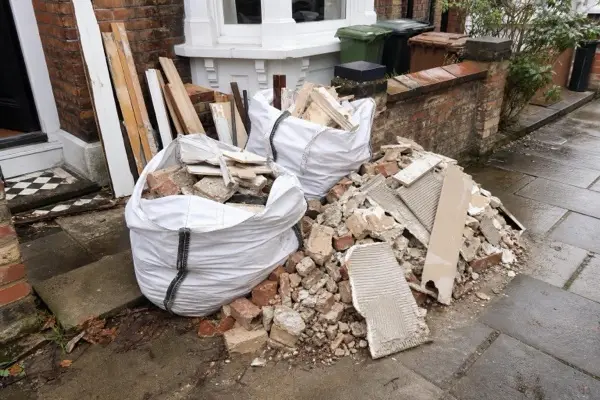
 Hi, can I get a price for this? SE15
How to Dispose of Plasterboard in London
Why plasterboard can’t go in a skip with everything else, which London tips accept it, what collection costs, and how to handle board in a pre-2000 property.
Read guide
Wood waste is the byproduct of activities such as logging and branch pruning. It contains uprooted and non-uprooted tree stumps as well as discarded trees.
The majority of this amount of waste originates from cities, where there is a lot of development, demolition, timber processing, and packing going on. Furniture, sawmills, pulp and paper mills, plywood mills, and particleboard mills are among the industries that contribute to the creation of used wood waste.
Companies have begun to appropriately dispose of their wood waste and reuse it when possible in recent years. We are an Environment Agency licensed waste carrier (CBDU527690), our crews wear the right PPE, and every collection comes with a waste transfer note – we can send you copies of our paperwork on request.
We provide a commercial waste collection service for construction companies and for businesses in any industry that produces timber or pallet waste, as well as for households.
We make every effort to ensure that as much of what we gather is repurposed rather than downcycled into chippings. We lessen the demand for imported timber and the environmental impact of the felling, processing, transfer, and transportation associated with it by pushing timber up the waste hierarchy and getting as much as possible back into the community for Do-It-Yourself or garden projects. Our lorries consume far less fuel than a skip lorry, resulting in lower carbon and particle emissions.
We'll take almost any waste, tree composites, furniture, and wooden goods, regardless of type or condition. 'Minimum Load' collections consist primarily of different types of heavy goods such as fire doors, kitchen equipment, or sheet material offcuts.
We have trained professionals who are always on time at your location. Our services are cost-effective, and the price is fixed before we arrive. At the end of the collection, we give you a waste transfer note.

The waste wood we collect falls into three grades. Grade A is clean wood: disused pallets, packing containers and cable drums, as well as manufacturing and joinery offcuts.
Grade B is construction and demolition timber, including solid wood furniture. Grade C is fuel-grade wood such as chipboard, blockboard, MDF, OSB and fibreboard. Timber treated with copper/chrome/arsenic (CCA) or creosote is grade D, which is hazardous waste – we don't collect it, and it must go to a licensed hazardous waste carrier.
We're organised and keen to provide exceptional customer service. We're fully insured, and we follow industry best practices for risk assessments and appropriate health and safety protocols.
We collect from homes, sites and businesses in all 32 London boroughs, 7 days a week. We are an Environment Agency licensed waste carrier (CBDU527690), and you get a waste transfer note for every load.
What happens to their waste after we've cleared it is a major concern for many clients. Where feasible, we recycle and encourage re-use. Our goal is to recycle more than our competitors and to develop new techniques to increase reuse. Wood recycling is part of our specialised service.
Our company ensures that we will always dispose of your waste responsibly and sustainably, whilst also being efficient and cost-effective. These are our company's guiding values.
Do you have any kind of waste on hand? Perhaps some garden waste has accumulated over time. Finding a cost-effective, environmentally responsible waste collection and removal service in London is straightforward with our removal company. For more information on our regular timber waste collection and disposal service in London, call us or visit our website.
No callbacks, no surprises. Snap a photo of your rubbish, send your postcode, get a fixed price back.
Office hours: Mon–Fri 6am–7pm, Sat 10am–5pm
Can’t see your question? Send us a photo on WhatsApp or call – we reply in minutes.
Practical tips on waste removal, recycling, and keeping your London property clear.
Why plasterboard can’t go in a skip with everything else, which London tips accept it, what collection costs, and how to handle board in a pre-2000 property.
Read guideWhat London tips will take, whether rubble can go in a skip, what a builder’s bag weighs, and when a collection beats doing it yourself.
Read guideThe decisions that actually cut event waste – cup systems, bin placement, trader rules – and the ones that only look good on paper.
Read guideTell us what needs to go and get a fixed price before we arrive. We do all the lifting, load the lorry and sweep up after.
Or call us free08 00 599 99 96