
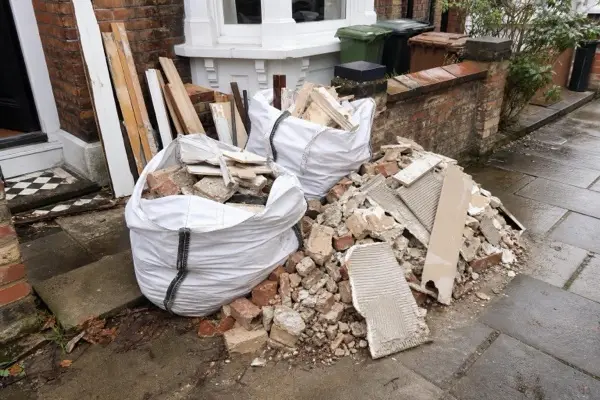
 Hi, can I get a price for this? SE15
How to Dispose of Plasterboard in London
Why plasterboard can’t go in a skip with everything else, which London tips accept it, what collection costs, and how to handle board in a pre-2000 property.
Read guide
This includes waste collected from toilets, showers, washrooms, sinks used for cleaning household spaces, sinks used for food preparation, clothing washing operations, and sinks or washing machines used to clean food and beverage serving dishes, glasses, and utensils.
Single and multiple residences, hotels and motels, restaurants, bunkhouses, schools, ranger stations, crew quarters, guard stations, campsites, picnic grounds, day-use recreation areas, other commercial facilities, and industrial facilities are all possible sources of this waste, as long as it is not mixed with industrial waste.
Sanitary waste is the result of a population that is not known to be contagious. It is classified as "offensive/hygiene waste" since it can be objectionable in appearance and smell. Handling offensive waste poses a residual health risk, which should be assessed and protections put in place.
Offensive waste is not clinical waste. Anything infectious, sharps or other clinical or hazardous waste must go to a licensed clinical waste contractor – we don't collect it.
Hygiene waste disposal is heavily controlled and managed by UK legislation to ensure that it is collected and disposed of in a safe and hygienic manner that is proportional to the level of risk it poses to human health.
Any hygiene waste you generate must be handled and disposed of safely. This waste should not be flushed into the toilet. Used nappies, sanitary towels, tampons, incontinence pads, and condoms are examples of sanitary products.
If you provide restrooms for employees and guests on your property, you must consider how you will dispose of offensive waste. As a business owner, it is your responsibility to ensure that any waste you generate is handled securely and legally.
You must only transfer your waste to sanitary waste disposal companies that are authorised to handle that type of waste as part of your duty of care. Locate a waste disposal facility near you. All waste you transmit or receive must be documented for a period of two years.
It is not advisable to flush the hygiene waste down the toilet. It may cause hygiene waste to pollute the sea, rivers, and beaches by clogging sewage pipelines at sewage treatment plants and septic tanks.
Install hygiene bins for female visitors and staff to dispose of their feminine hygiene waste products. All female and unisex commercial washrooms, disabled female toilets, and baby changing stations should have them. This may save you money on drain cleaning.

Hygiene waste can be categorised under the following:
Slimline sanitary bin: a cost-effective, practical bin with a sleek design that conserves cubicle space, bio-fresh inserts that prevent undesirable odours, and anti-microbial coating that minimises the spread of germs. Manual and no-touch versions are available.
Standard hygiene bin: comes in a choice of colours and operations and suits a variety of settings.
Large sanitary bin: available in various colours and operations for busier washrooms. Bio-fresh inserts help to eliminate odours.
The large modesty flap makes waste disposal simple. Anti-microbial layer prevents germs from spreading. Manual, pedal and no-touch options are all available.
Effective waste disposal: Our waste bins are pedal-operated and adaptable to all cubicle sizes, making them a safe and hygienic standard.
Environmentally friendly: Your hygiene waste is kept out of landfill wherever possible and sent to licensed energy-from-waste facilities, where it is converted into energy.
Discreet service: We can handle your waste bin collections in a way that causes the least amount of disruption to your employees and guests, thanks to a customised schedule process. Any London Waste services washrooms in offices, schools, gyms, salons and other premises across all 32 London boroughs, so we can build a solution to meet your needs.
Low maintenance: Our Any London Waste crew will change the bin liners and clean the area, then notify you when they are finished.
Many individuals are unaware of the legal requirement binding a business owner in the United Kingdom. You are legally compelled to follow a set of sanitary waste regulations. These sanitary waste disposal legislation are:
The Environmental Protection Act 1990: The Environmental Protection Act of 1990 (EPA) brings together the IPPC (Integrated Pollution Prevention and Control) system for raw material use, waste avoidance (or minimisation), energy efficiency, and waste disposal to land, water, and air.
Anyone who imports, produces, transports, maintains, handles, or disposes of controlled waste, or has control of such material as a broker, owes a duty of care under Section 34 (1) of the Environmental Protection Act 1990.
This law states that it is the obligation of each business to collect, store, and dispose of waste generated on their premises. Hygiene waste is included in this category. Waste management takes time, which is why many business organisations hire an external hygiene waste disposal professional to handle it for them.
The Workplace (Health, Safety, and Welfare) Regulations 1992: The workplace (Health, Safety, and Welfare) Regulations of 1992 apply to most workplaces and cover a wide variety of essential health, safety, and welfare issues. Workplaces must address the health, safety, and welfare needs of all employees, including those with disabilities, according to the regulations.
The Water Industries Act 1991: The Water Industry Act 1991 is a United Kingdom Parliament Act that merges prior enactments in England and Wales dealing with water supply and wastewater services.
This law regulates the flushing of waste down the toilet as a method of waste disposal. It stipulates that no waste that could clog a sewer or drain should be flushed. If proper hygiene disposal facilities are not available, people may dispose of hygiene waste down the toilet, resulting in blockages and costly repairs.
No callbacks, no surprises. Snap a photo of your rubbish, send your postcode, get a fixed price back.
Office hours: Mon–Fri 6am–7pm, Sat 10am–5pm
Can’t see your question? Send us a photo on WhatsApp or call – we reply in minutes.
Practical tips on waste removal, recycling, and keeping your London property clear.
Why plasterboard can’t go in a skip with everything else, which London tips accept it, what collection costs, and how to handle board in a pre-2000 property.
Read guideWhat London tips will take, whether rubble can go in a skip, what a builder’s bag weighs, and when a collection beats doing it yourself.
Read guideThe decisions that actually cut event waste – cup systems, bin placement, trader rules – and the ones that only look good on paper.
Read guideTell us what needs to go and get a fixed price before we arrive. We do all the lifting, load the lorry and sweep up after.
Or call us free08 00 599 99 96